
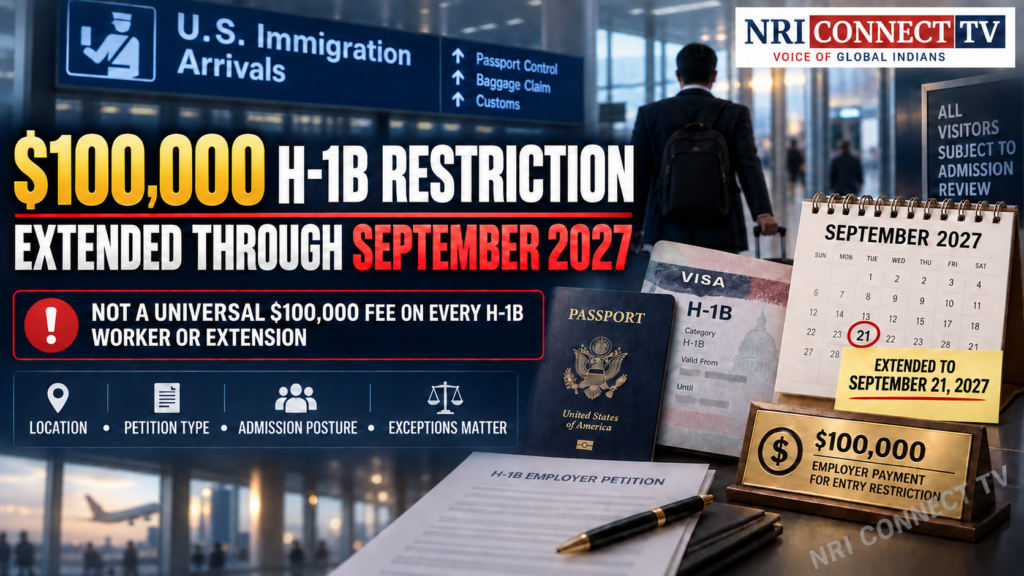
President Donald Trump issued a proclamation September 18 extending for another year the controversial H-1B entry restriction tied to a $100,000 employer payment. The proclamation says the restriction will continue until September 21, 2027, subject to specified national-interest exceptions. For Indian professionals and employers, the key point is that the proclamation is not a $100,000 charge on every H-1B holder or every H-1B extension.
The policy applies to the entry of specified H-1B workers whose petitions are subject to the proclamation and who must seek admission to the United States to effectuate petition approval.
What exactly was extended?
The original restriction was imposed in September 2025. The September 18 proclamation says entry as an H-1B specialty-occupation worker remains restricted unless the relevant petition is accompanied or supplemented by the $100,000 payment, subject to exceptions.
For covered workers outside the United States, DHS is directed to restrict decisions on petitions lacking the payment during the extended period. Employers filing for affected workers outside the country must obtain and retain documentation showing the payment was made. State is directed to verify payment during the visa process.
Who should not assume the rule applies?
The proclamation’s scope matters enormously. It states that the restriction applies to people who enter or attempt to enter after the proclamation’s effective date and who must seek admission to effectuate approval of a covered petition, including through consular notification or a port of entry.
That means an H-1B employee already working in the United States should not read “$100,000 H-1B fee” and automatically assume their employer owes $100,000 for every routine immigration transaction.
Are there exceptions?
Yes. The proclamation allows DHS to determine that the restriction does not apply to an individual, employees of a company or workers in an industry where the hiring is considered in the national interest and does not threaten U.S. security or welfare. Applicants should not assume they qualify for such an exception without an actual government determination.
What does the administration say the policy accomplished?
The proclamation says the administration observed substantial declines in registrations from major IT staffing and outsourcing firms and fewer consular-processing requests after the original policy. Those are administration assertions and statistics used to justify the extension, not NRI Connect TV’s independent assessment of whether the policy has improved the labor market.
Source: restriction-on-entry-of-certain-nonimmigrant-workers-faad/












Follow NRI Connect where you already are.