
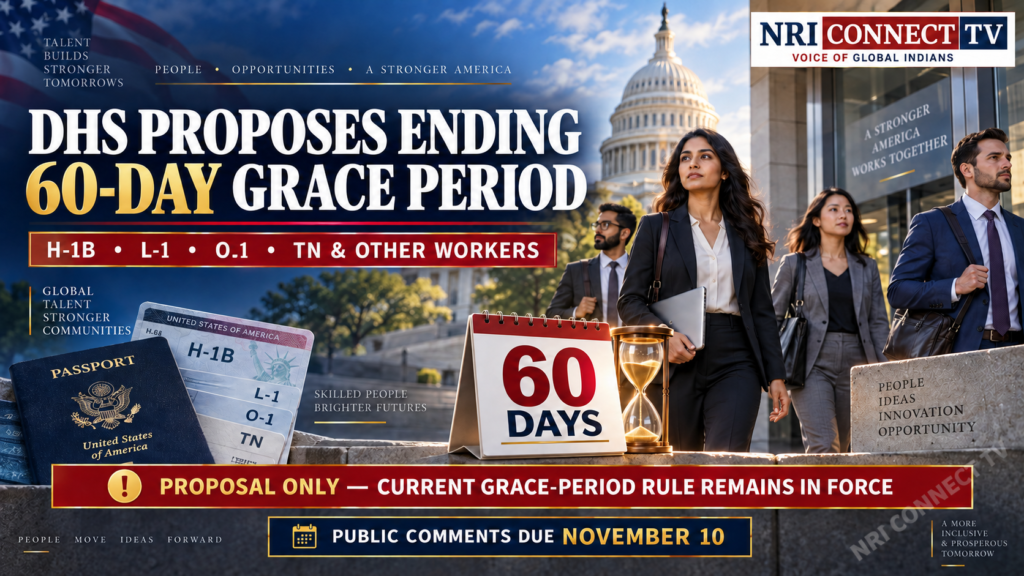
DHS published a proposed rule September 11 that would eliminate the up-to-60-day discretionary grace period currently available after employment ends for workers in E-1, E-2, E-3, H-1B, H-1B1, L-1, O-1 and TN classifications and their dependents. The proposal is important, but the most urgent fact for workers is equally simple, the 60-day provision has not been eliminated yet.
What does today’s rule allow?
Since 2017, DHS regulations have permitted qualifying workers whose employment ends to be treated as maintaining status for up to 60 consecutive days or until the end of their authorized validity period, whichever is shorter unless DHS shortens or eliminates the discretionary period in an individual case. That period can provide time to pursue a qualifying change of employer, change of status or departure. It is not an automatic extra 60 days beyond the I-94 expiration date.
What is DHS proposing?
DHS proposes removing 8 CFR 214.1(l)(2).
The department says this would restore the pre-2017 approach under which affected workers generally were expected to depart after the qualifying employment ended unless another lawful basis for remaining existed. DHS says it considered shortening rather than eliminating the period but rejected that alternative.
Who could be affected?
The proposal reaches much further than H-1B. It covers principal workers and dependents in the specified E, H-1B/H-1B1, L-1, O-1 and TN classifications. For Indian nationals, H-1B and L-1 are particularly significant.
Does a laid-off H-1B worker need to leave immediately now?
Not because of this proposal. A proposed rule does not change the existing regulation.
Someone laid off today should assess their existing grace-period eligibility and I-94 validity under current law rather than assume the September 11 NPRM has already eliminated the period.
Hypothetical: An H-1B employee loses a job September 20. The proposed rule’s publication alone does not mean the employee has zero grace period. Current regulations remain relevant unless and until a final rule changes them.
Individual facts can nevertheless affect eligibility, so legal advice may be important.
What happens next?
Written comments are due by November 10, 2026. DHS would need to complete the rulemaking process before a regulatory change becomes effective. The final rule could differ from the proposal.
Bottom line
The administration is seeking to eliminate the 60-day grace period, but it has not done so yet.












Follow NRI Connect where you already are.