
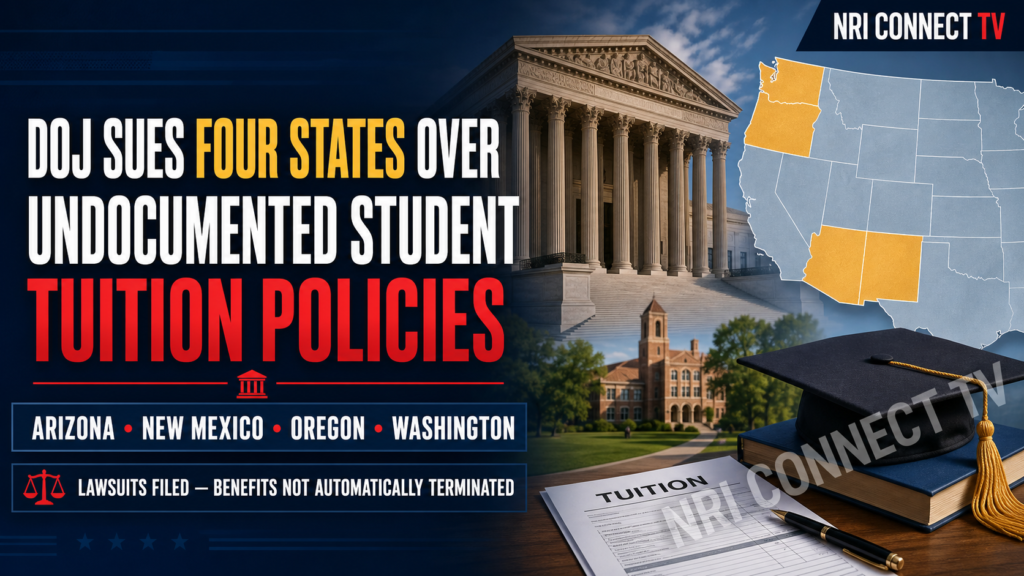
The Justice Department filed four lawsuits August 27 challenging state policies that allow certain undocumented students to receive in-state tuition rates or financial assistance in Arizona, New Mexico, Oregon and Washington. The filings open new federal court battles; they do not by themselves mean the challenged tuition benefits ended on August 27.
DOJ is asking the courts to declare the relevant provisions unlawful and prevent the states from enforcing them. Its position is that the challenged state laws conflict with federal immigration law by providing benefits to people without lawful status that are unavailable to certain U.S. citizens. The states will have the opportunity to contest those claims in court.
DOJ said the four August 27 complaints brought its total number of state tuition challenges to 21. The department also said similar litigation had already produced favorable orders involving Texas, Kentucky, Oklahoma, Nebraska and Illinois, while cases involving additional states remained pending. Those outcomes should not be automatically projected onto the four newly filed cases because each state’s law, procedural posture and court record can differ.
What does the Arizona complaint say?
DOJ highlighted Arizona data in particular. Its announcement says the complaint cites information showing at least 720 undocumented students received in-state tuition at Arizona public colleges and universities in fall 2025, including 432 at Arizona State University. DOJ also alleges that the roughly $24,000 resident-versus-out-of-state tuition difference at ASU translated into approximately $10.5 million in reduced tuition there.
Those figures are claims and supporting figures cited by DOJ in litigation. They should not be reported as a nationwide measure or as a final judicial finding.
Does this affect F-1 international students?
Not automatically. F-1 immigration status, state residency classification and eligibility for state tuition benefits are distinct questions. The August 27 lawsuits concern specific state provisions DOJ says benefit people who are not lawfully present.
What should students do now?
Students currently relying on a challenged program should check guidance from their university and the responsible state higher-education authority. Do not withdraw from school, change enrollment or assume a new tuition bill merely because DOJ filed a complaint. The important next events will be motions for preliminary injunctions, court orders, settlements, appeals or state legislative changes.
Why this matters for prospective students
Tuition classification can materially change the cost of a U.S. degree. Families comparing universities in the four states should therefore distinguish:
- the tuition rate currently quoted by the institution;
- the student’s present eligibility basis;
- whether that eligibility depends on a provision under federal challenge; and
- whether a court has actually issued an operative order.
Primary source: Justice Department August 27 announcement












Follow NRI Connect where you already are.