
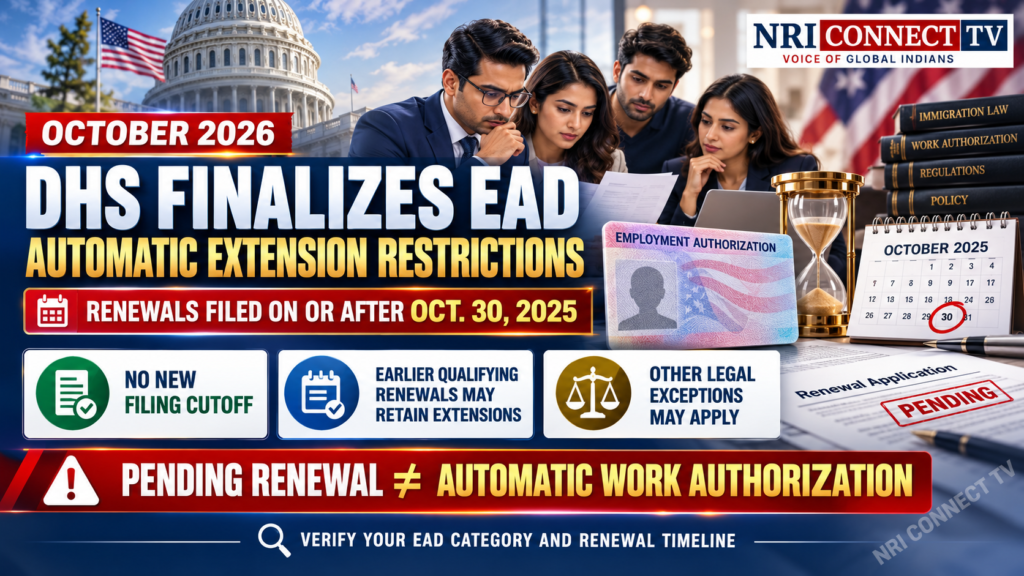
WASHINGTON, October 14, 2026 – The Department of Homeland Security has finalized a rule restricting automatic extensions of certain Employment Authorization Documents (EADs), confirming that eligible renewal applications filed on or after October 30, 2025, generally do not receive the previously available extension of up to 540 days.
The final rule was published and took effect on October 14, 2026. It adopts without change an interim final rule introduced one year earlier.
The October 2026 action confirms an existing restriction; it does not establish a new October filing cutoff.
For Indian nationals awaiting green cards, certain dependent spouses and other workers relying on EADs, the distinction between filing dates and authorization categories is essential.
What changed on October 14?
DHS finalized amendments to federal employment-authorization regulations, including 8 CFR 274a.13.
The rule confirms that submitting a renewal Form I-765 generally does not automatically extend employment authorization or EAD validity when the renewal was filed on or after October 30, 2025.
Previously, certain eligible applicants could receive an automatic extension of up to 540 days while USCIS processed their renewals. DHS says the restriction supports renewed screening and verification before extending employment authorization.
The agency adopted the earlier interim rule without changes after reviewing public comments.
Does the rule affect everyone with an EAD?
No.
The regulation concerns automatic extensions associated with certain EAD renewal applications. It does not automatically cancel valid, unexpired EADs or eliminate the ability to apply for renewal. It also does not mean every noncitizen worker relies on an EAD for employment authorization.
For example, some employment-authorized nonimmigrants work based on their immigration classification and employer-specific authorization rather than an EAD card. Applicants should identify their precise eligibility category instead of assuming the rule applies identically to all visa holders.
What happens to renewals filed before October 30, 2025?
The final rule preserves qualifying automatic extensions based on properly and timely filed renewal applications received before October 30, 2025.
Applicants must still satisfy the applicable eligibility conditions. For qualifying cases, an expired EAD together with the appropriate Form I-797C receipt notice may establish an extension of up to 540 days.
The filing receipt date matters. Merely mailing an application before the cutoff does not necessarily establish timely receipt by USCIS. The rule also clarifies that an automatic extension of an EAD does not extend the advance-parole component of a combined employment and travel document.
Are there exceptions after the cutoff?
Yes.
DHS preserves automatic extensions available under other legal provisions or applicable Federal Register notices, including certain Temporary Protected Status arrangements.
The precise exception depends on the person’s immigration classification, employment-authorization category and governing notice. Applicants should not assume they qualify merely because an earlier EAD was automatically extended. Likewise, employers should not assume that every expired card paired with a renewal receipt remains valid for employment verification.
Why does this matter to Indian green card applicants?
Many Indian nationals face lengthy employment-based green card waiting periods.
Some adjustment-of-status applicants rely on category C09 EADs while their permanent-residence applications remain pending.
A timely renewal filing can preserve an application for continued employment authorization, but under the finalized rule it generally does not create an automatic extension when filed on or after the October 2025 cutoff.
If USCIS has not approved the renewal before the existing authorization expires, a work-authorization gap may arise. The outcome depends on the applicant’s category and whether another legal basis permits continued employment.
What about H-4 spouses and F-1 students?
H-4 dependent spouses and F-1 students using employment authorization should review the rules governing their specific categories.
The October final rule does not replace every separate provision concerning H-4 employment authorization, F-1 practical training or work authorization tied to another status.
An applicant’s underlying immigration status, employment authorization and EAD validity are related but distinct legal questions. General headlines about ending automatic EAD extensions should not substitute for category-specific guidance.
What should workers and employers do?
Applicants should review their EAD expiration dates, USCIS receipt notices, eligibility categories and renewal filing windows.
They should also check current USCIS processing guidance and identify whether a statutory or notice-based exception applies.
Employers should use current Form I-9 instructions when determining which documents establish continuing employment authorization.
Neither a pending renewal nor an expired EAD should automatically be treated as sufficient without reviewing the applicable rules.
Official source: https://www.govinfo.gov/content/pkg/FR-2026-10-14/html/2026-20955.htm
Stay Connected with NRI Connect TV
Get the latest community news, cultural events and updates. Follow our WhatsApp Channel.












Follow NRI Connect where you already are.