
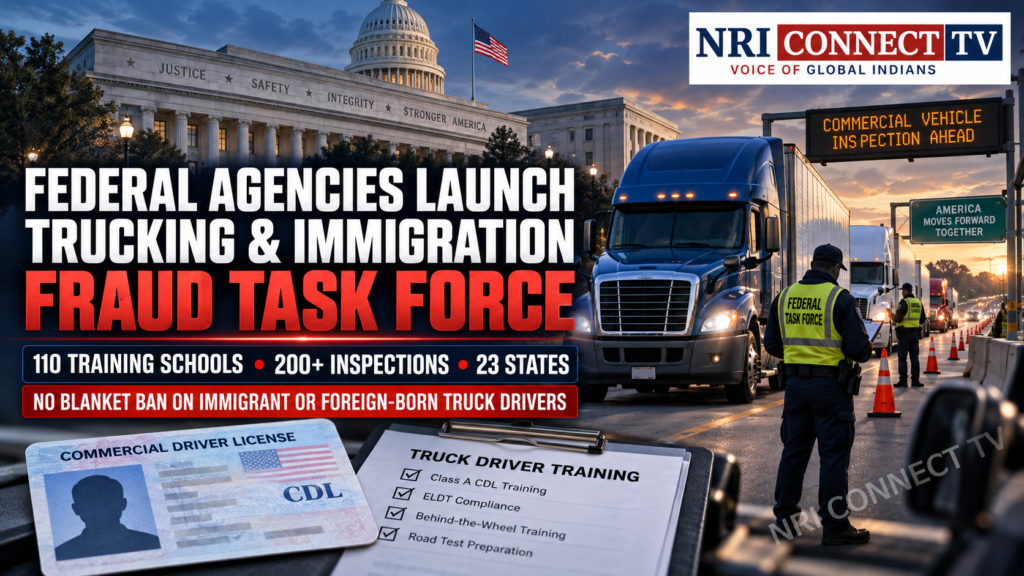
The Justice Department, Department of Homeland Security and Department of Transportation launched a major multi-state enforcement initiative on August 31 targeting alleged fraud involving commercial driver’s licenses, driver-training schools, trucking employers and immigration violations. The action is significant for transportation businesses and foreign-born drivers, but it does not create a blanket prohibition on immigrants or visa holders obtaining or using commercial driver’s licenses.
The coalition is called Joint Task Force Crossroads of America and initially brings together federal prosecutors in Illinois, Indiana, Michigan and Ohio with agencies including ICE, Homeland Security Investigations, the FBI, DEA, ATF and federal transportation regulators.
What did federal agencies announce?
FMCSA announced emergency removal of 110 CDL training schools associated with more than 5,000 drivers who had failed English-language-proficiency tests. Officials also announced a nationwide audit of third-party CDL skills testers and investigations involving additional training providers.
DHS said Homeland Security Investigations planned an August 31 surge involving more than 200 driving schools across 23 states, primarily through notices of inspection and coordinated investigations.
The government says investigators are looking at suspected fraudulent licensing, unauthorized employment, identity fraud, shell companies, training irregularities and other transportation-sector violations.
One ongoing investigation cited by DOJ involves a trucking company suspected of employing B-1/B-2 visa holders for domestic cargo transport. Visitor visas generally are not employment authorization for ordinary U.S. trucking work.
Does this create a new immigration rule?
No.
The initiative combines existing immigration, employment-verification, licensing, transportation-safety and criminal-enforcement authorities. It does not create a new visa category, eliminate valid CDLs held by lawful immigrants or declare that foreign-born drivers are inherently ineligible to operate commercial vehicles.
That distinction matters for Indian nationals working in logistics or owning transportation companies. A lawful permanent resident, employment-authorized worker or other foreign-born driver can still be legally employed if the person meets immigration, employment and licensing requirements.
What should employers review?
Trucking employers should treat immigration compliance and CDL compliance as separate but overlapping obligations.
Companies should confirm that workers have appropriate employment authorization, that Form I-9 records are handled correctly, that driver qualifications are valid and that training providers relied upon by the company remain compliant. An enforcement notice or inspection should also be reviewed carefully before records are produced.
The task force is designed for continuing investigations rather than a one-day operation. Additional training-provider removals, criminal charges, employer inspections and CDL enforcement actions are likely. Businesses should therefore monitor FMCSA, DHS and DOJ rather than relying on social-media lists claiming that particular nationalities have been banned from trucking.
Source – More Information












Follow NRI Connect where you already are.