
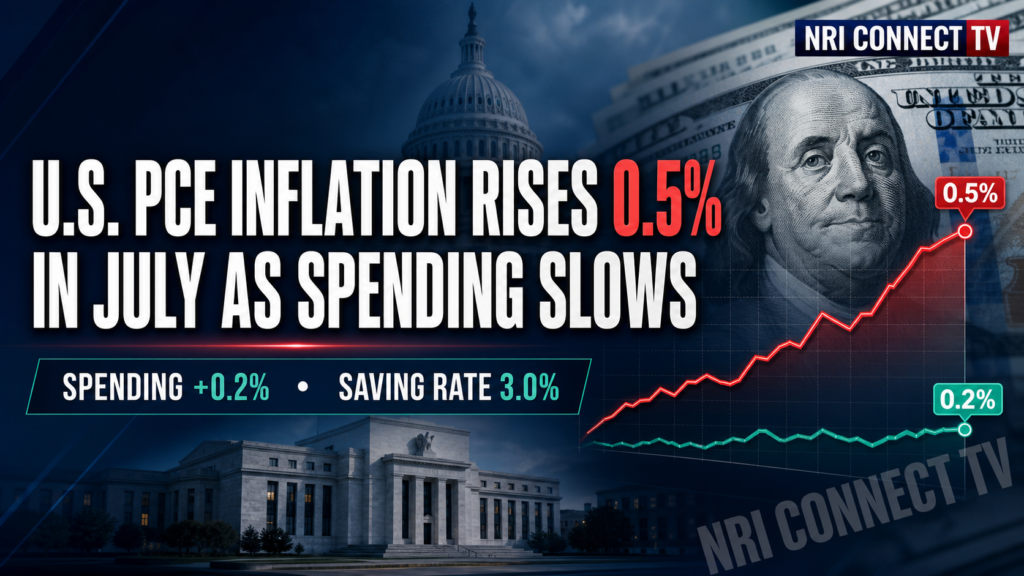
U.S. consumers increased spending more slowly in July while prices moved higher, according to official figures released August 26 by the Bureau of Economic Analysis. July 2026 PCE inflation rose 0.5% from June, while personal consumption expenditures increased 0.2%. Personal income rose 0.4%.
For households, borrowers and investors, the combination matters because the PCE price index is an important measure of U.S. inflation and feeds into the broader interest-rate outlook.
BEA – Personal Income and Outlays, July 2026
What changed in July?
BEA reported that personal income increased $115.1 billion, or 0.4%, while disposable personal income increased $125.9 billion, or 0.5%.
Consumer spending increased $36.3 billion, or 0.2%. The composition was uneven: services spending increased $86.2 billion while spending on goods fell $49.9 billion.
The personal saving rate increased to 3.0%, compared with 2.7% in June.
| Measure | June | July |
|---|---|---|
| Personal income growth | 0.2% | 0.4% |
| Disposable income growth | 0.2% | 0.5% |
| Consumer-spending growth | 0.3% | 0.2% |
| Saving rate | 2.7% | 3.0% |
Inflation remains the key financial signal
The PCE price index increased 0.5% month over month in July. Excluding food and energy, the index increased 0.3%.
Compared with July 2025, headline PCE prices were 4.1% higher, while core PCE inflation was 3.5%.
That does not mean every household’s cost of living increased by exactly those percentages. PCE is an economy-wide price index, while individual households have different spending patterns.
What should readers watch next?
The Federal Reserve does not set interest rates mechanically from one inflation report, so today’s figures should not be interpreted as guaranteeing a rate move.
The next BEA Personal Income and Outlays release is scheduled for September 30, 2026, covering August.
July’s data show income rising faster than consumer spending, alongside a higher saving rate—but inflation remains elevated. Households should treat the report as an economic signal rather than a prediction of their personal expenses or the Federal Reserve’s next decision.












Follow NRI Connect where you already are.