
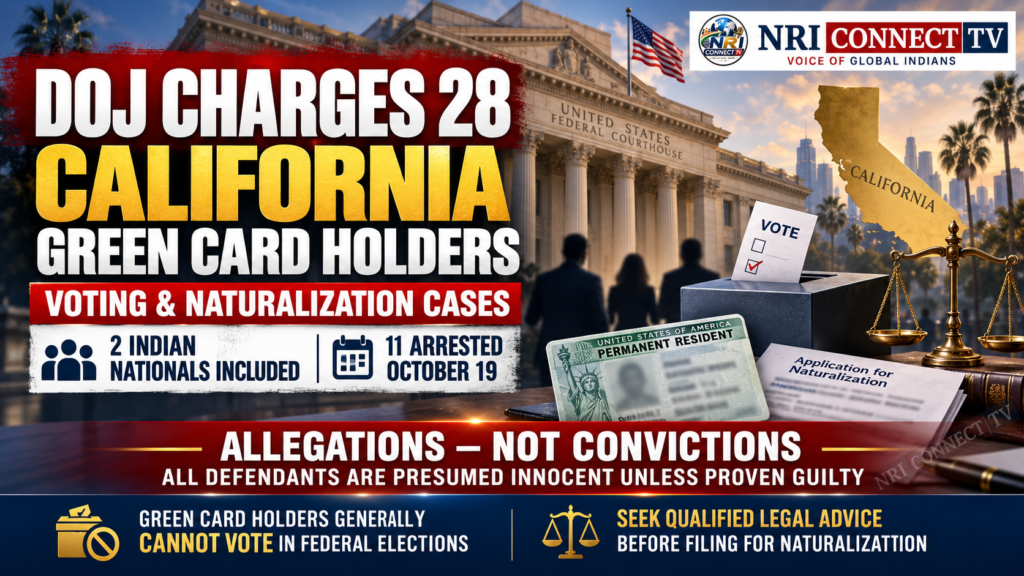
WASHINGTON, October 23, 2026 – The U.S. Department of Justice has charged 28 lawful permanent residents in California with federal offenses involving alleged unlawful voting, voter registration and statements made during naturalization proceedings. Federal authorities announced the cases on October 19 and arrested 11 defendants that day.
Two Indian nationals are among those charged. The allegations have not been proven in court, and all defendants are presumed innocent unless proven guilty.
The cases highlight an important distinction for immigrants: holding a green card permits lawful permanent residence, but it does not confer U.S. citizenship or the right to vote in federal elections.
What did the Justice Department announce?
The cases involve federal prosecutors in California’s Eastern, Central, Northern and Southern districts.
According to DOJ, all 28 defendants are lawful permanent residents. Prosecutors allege that some registered to vote by falsely identifying themselves as U.S. citizens, some cast ballots, and some subsequently provided inaccurate information in citizenship applications or interviews.
The charges differ among defendants. They include alleged unlawful voting, false statements and attempts to obtain naturalization contrary to law.
Federal officials described the prosecutions as part of a coordinated election-integrity enforcement effort. Those characterizations reflect the department’s position; criminal responsibility must be established individually through the courts.
Can green card holders vote?
A lawful permanent resident is not automatically a U.S. citizen. Green card holders generally cannot vote in federal elections, including presidential and congressional elections. Certain jurisdictions may have different rules for limited local elections, so the applicable election and immigration laws must be distinguished carefully.
However, a person should never claim U.S. citizenship on a registration form unless that statement is true. USCIS guidance also explains that unlawful voting, improper registration and false citizenship claims can affect eligibility for naturalization.
Why naturalization applications matter
Form N-400 asks applicants about matters relevant to their eligibility for citizenship. Voting history and previous claims of U.S. citizenship can become significant during that process. An applicant who incorrectly registered to vote should not attempt to conceal the incident or provide an inaccurate answer during a citizenship interview.
The appropriate legal response depends on the circumstances, including what the applicant understood, what representations were made and which legal provisions apply. An incorrect registration does not establish that every possible immigration consequence automatically follows.
What if someone was registered by mistake?
Permanent residents who discover an unexpected voter registration should seek qualified legal advice before making statements or submitting naturalization paperwork. They should preserve relevant records, including registration correspondence and any available information about whether a ballot was issued or cast.
They should also avoid assuming that simply canceling a registration resolves every potential immigration issue. A qualified immigration attorney can assess whether the facts raise concerns under citizenship, admissibility, deportability or criminal-law provisions.
What happens next?
The 28 cases will proceed through their respective federal courts. DOJ’s October 19 announcement did not establish that all defendants had been convicted, nor did it mean they would receive identical penalties. The eventual outcomes depend on the charges, evidence, applicable law and judicial proceedings.
Official source: https://www.justice.gov/opa/pr/justice-department-charges-28-foreign-nationals-california-election-crimes
Stay Connected with NRI Connect TV
Get the latest community news, cultural events and updates. Follow our WhatsApp Channel.












Follow NRI Connect where you already are.