
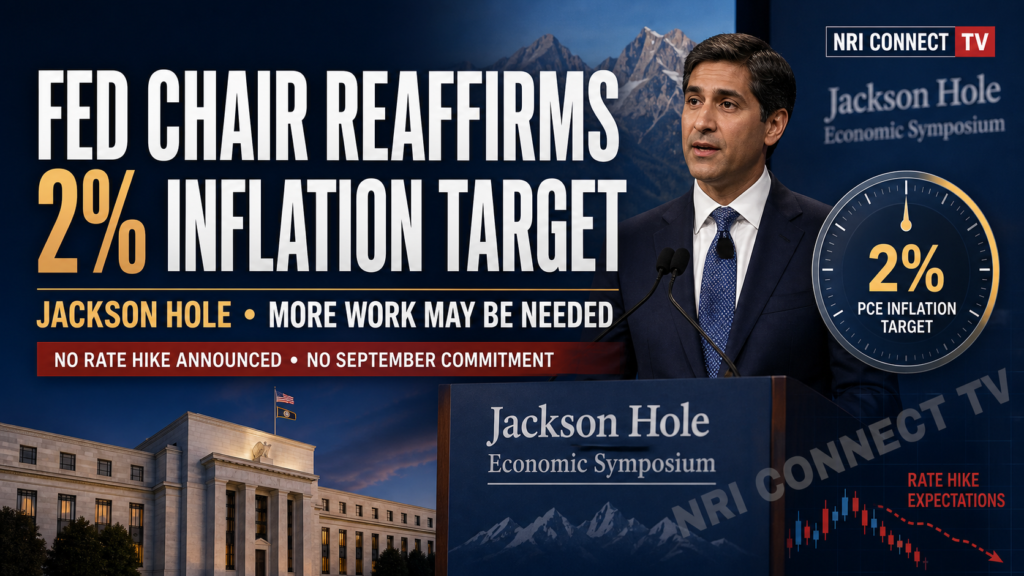
Federal Reserve Chair Kevin Warsh used his August 28 Jackson Hole address to make clear that the fight against inflation is not finished, reinforcing the Fed’s 2% PCE inflation target and saying policymakers still have work to do unless they are confident underlying inflation is returning to that goal. But he did not announce a rate hike, and his speech should not be reported as a September rate decision.
That distinction matters for borrowers, savers, businesses and Indian-origin families managing finances across the United States and India.
What did Warsh actually say?
Warsh described 2% PCE inflation as a “firm, fixed target.” He also emphasized that short-term interest rates remain the Fed’s main monetary-policy tool and said policymakers need confidence that inflation is moving toward target at an adequate pace.
He simultaneously pushed back against routine forward guidance the practice of signaling future rate decisions well in advance. His broader argument was that markets should process economic information themselves rather than look primarily to the central bank for the next trade.
That makes the speech more nuanced than a simple “rates will rise” headline.
Reuters reported that financial markets nevertheless interpreted Warsh’s tone as more hawkish. Two-year Treasury yields climbed and rate markets moved toward assigning a higher probability to a September increase following the speech. Those are market expectations, however, not an official Federal Reserve commitment.
What does this mean for household borrowing?
A higher federal-funds target can eventually contribute to higher costs for credit cards, variable-rate debt and some business borrowing. But mortgage rates and longer-term yields are also influenced by inflation expectations, Treasury-market conditions and broader economic forecasts.
That means a family considering a mortgage should not assume that one Fed speech mechanically changes its available rate the next morning. Similarly, savings-account and CD yields can respond to monetary-policy expectations, but individual banks set their own rates.
Why should Indian-origin families watch this closely?
Cross-border families often have several financial channels exposed to U.S. rates: mortgages, student loans, business credit, savings and investment portfolios.
There can also be an indirect currency dimension. Changes in U.S. rate expectations can affect the dollar, although USD/INR moves depend on many additional U.S., Indian and global factors. The speech therefore is not a reliable standalone currency forecast.
What happens next?
The important distinction is between communication and action. Warsh has described his monetary-policy principles, but the FOMC makes rate decisions through its formal meetings. Inflation and employment data released before the next decision can materially change the outlook.












Follow NRI Connect where you already are.