
What changed?
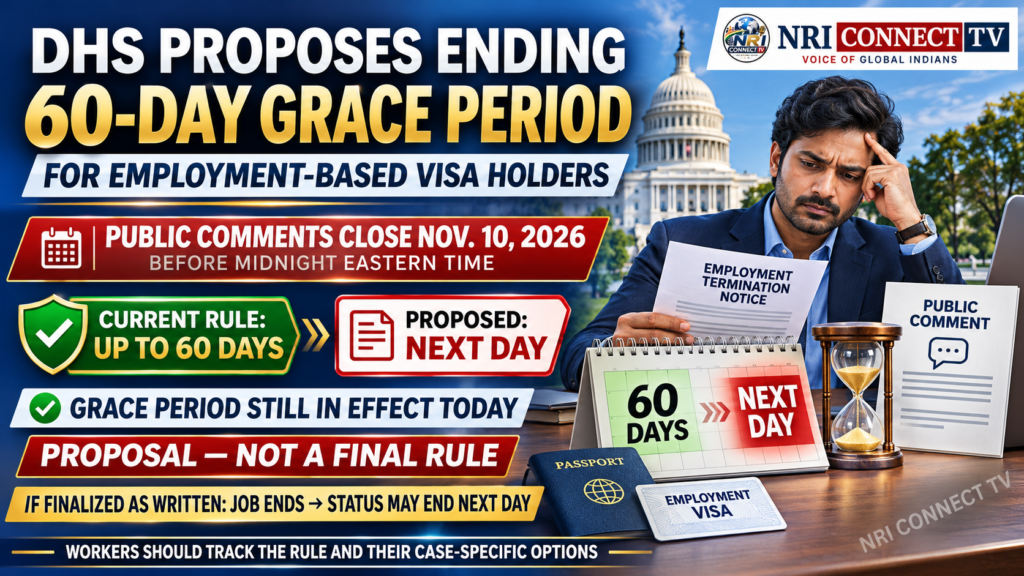
Nothing has changed yet and that is the point readers must not miss. On September 11, 2026, DHS published a notice of proposed rulemaking titled “Eliminating the Discretionary 60-Day Grace Period” (91 FR 57807). The proposal would delete the regulation at 8 CFR 214.1(l)(2) that gives certain nonimmigrant workers up to 60 days after their qualifying employment ends during which they are not considered to have failed to maintain status solely because the employment ended.
The comment period for that proposal closes Tuesday, November 10, 2026, before midnight Eastern Time. Comments must be filed through the Federal eRulemaking Portal at regulations.gov, under DHS Docket No. USCIS-2026-0364. The proposal is not final, and no effective date has been set. DHS must review the comments before it can publish any final rule.
Why this matters to NRIs and Indian-origin families
The 60-day grace period is one of the most-used safety nets for Indian professionals in the United States. H-1B workers form the largest group of Indian nationals on employment-based visas, and a layoff is the moment the rule matters most. Today, a worker whose job ends can use up to 60 days to find a new sponsor, file for a change of status, or make other arrangements without being treated as out of status for that reason alone.
If the proposal is finalized as written, that buffer disappears. A worker would generally be expected to depart the United States immediately when the employment that supported their status ends, unless they are otherwise authorized to remain. For families, the stakes are higher still: the grace period also covers dependents, and a sudden loss of status can disrupt children’s schooling, a spouse’s work authorization, and a pending green-card process.
Who is affected and who is not?
Affected if the proposal is finalized: Workers in E-1, E-2, E-3, H-1B, H-1B1, L-1, O-1 and TN status, and their eligible dependents. The proposal also touches the related rule at 8 CFR 204.5(p)(1)(i), which concerns a compelling-circumstances employment authorization document that can be sought during the grace period.
Not affected: Workers whose status does not depend on the listed classifications people who already hold permanent residence; and anyone whose employment has not ended. The proposal does not change the validity period of an approved petition, and it does not itself cancel anyone’s visa stamp.
Important distinction: The grace period is discretionary, not a guaranteed 60 days in every case. DHS can shorten or eliminate it in an individual case today, and it applies only where the worker’s authorized period of stay has not already expired.
How many people may be affected?
No authoritative count of how many people use the grace period each year was found in the material reviewed. DHS received nearly 3,000 comments on the proposal, according to the withdrawal-era record in the Federal Register notice itself but comment volume is not a count of affected people. As of the morning of November 9, 2026, 28,282 comments had been posted on the grace-period docket (regulations.gov, as read through a public tracker) that figure counts posted comments, not people, and it will have risen during the day.
What affected readers should do next
Do now
- If you want to comment, write in your own words about your own experience: what the grace period would mean to you if you lost a job, and what evidence supports your point. DHS says the most useful comments reference a specific part of the proposal, explain the reason for the recommendation, and include data or authority.
- Submit only through regulations.gov under Docket No. USCIS-2026-0364. Emails or letters to DHS or USCIS officials are not counted as comments on the proposal.
- Do not include more personal information than necessary, comments are posted publicly.
Frequently asked questions
Is the 60-day grace period already gone?
No. It is a proposal published September 11, 2026. The current regulation, 8 CFR 214.1(l)(2), remains in effect today.
Who does the proposal cover?
Workers in E-1, E-2, E-3, H-1B, H-1B1, L-1, O-1 and TN status, and their dependents.
When do comments close?
Tuesday, November 10, 2026, before midnight Eastern Time, through regulations.gov under Docket No. USCIS-2026-0364.
What happens if I miss the deadline?
Late comments are not part of the rulemaking record. The deadline is the last chance to comment on this proposal.
If the rule is finalized, when would it take effect?
A final rule would state its own effective date. No date has been set, and the proposal itself sets none.
Does the proposal affect my current H-1B petition or visa stamp?
No. It does not cancel approved petitions or visa stamps. It changes what happens after qualifying employment ends.
Can I comment if I am not in the United States?
DHS invites all interested parties to participate. Comments must be in English or include an English translation.
Source: Read the proposed rule in the Federal Register












Follow NRI Connect where you already are.