
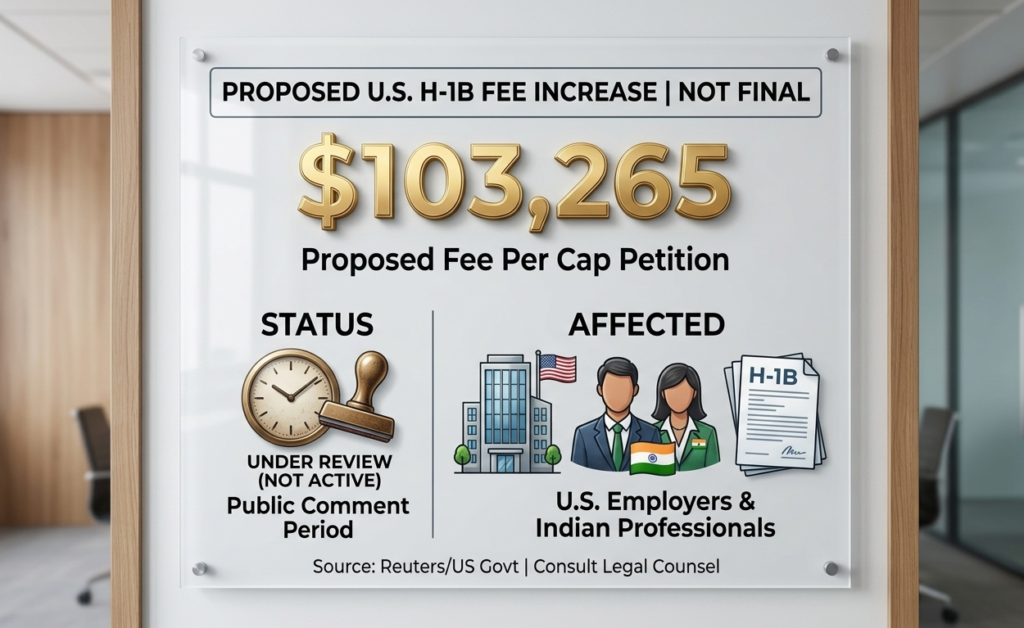
The U.S. Department of Homeland Security has proposed a new $103,265 fee for H-1B cap-subject petitions, a potentially significant change for employers sponsoring Indian professionals and other foreign workers through the annual H-1B cap process.
The most important point for workers and employers is that the fee is only a proposal at this stage. It is not currently an operative $103,265 filing charge under this rule.
DHS’s notice of proposed rulemaking says the fee would be payable when a covered H-1B petition is filed and would apply to cap-subject petitions, including those eligible for the advanced-degree exemption. It would be charged in addition to other applicable fees or payments.
Who would have to pay the proposed fee?
The proposal targets H-1B cap-subject petitions, rather than every H-1B filing. That includes petitions associated with the regular H-1B numerical cap and those eligible for the advanced-degree exemption. DHS proposes creating the $103,265 amount as a separate additional H-1B fee instead of incorporating it into the existing petition fee.
This distinction matters for Indian workers already in H-1B status. The announcement should not be interpreted as saying that every H-1B worker, extension, amendment or employer automatically owes $103,265. DHS specifically says the proposed charge would apply only to cap-subject petitions, not to all H-1B petitions such as cap-exempt filings.
Do employers have to pay $103,265 now?
No. The Federal Register document is explicitly labeled a Notice of Proposed Rulemaking. It was released for public inspection on August 24 and is scheduled for Federal Register publication on August 25, 2026. DHS is opening the proposal to public comments. The public-inspection version provides for a 30-day comment period following Federal Register publication.
A proposed rule can change before becoming final. DHS would have to complete the rulemaking process before this proposal could create an effective fee. Employers and H-1B candidates therefore should not treat headlines about the $103,265 figure as notice that the money is currently due.
Why did DHS arrive at $103,265?
DHS says the proposed charge is intended to recover part of the federal government’s costs of administering the lawful immigration system across agencies including USCIS, Customs and Border Protection, Immigration and Customs Enforcement, the Department of Justice, State Department and Department of Labor.
The proposed rule identifies $8,777,488,035 in costs to be recovered and divides that figure by a projected 85,000 fee-paying petitions. That calculation produces $103,264.57, which DHS rounded to $103,265. The resulting annual revenue would therefore be roughly $8.8 billion if DHS’s assumptions were realized.
Cap-subject versus cap-exempt H-1B cases
| H-1B situation | Proposed $103,265 fee |
|---|---|
| Regular cap-subject petition | Would apply |
| Advanced-degree exemption petition | Would apply |
| Cap-exempt H-1B petition | Would not apply under proposal |
| Fee payable today under this proposed rule | No |
Certain qualifying institutions of higher education, affiliated nonprofits, nonprofit research organizations and governmental research organizations can be associated with cap-exempt H-1B employment under existing law. Whether a particular petition is cap-subject or cap-exempt depends on the actual case. Workers should not determine their status from employer type alone without reviewing the applicable requirements.
Why this matters particularly to Indian professionals
Indian nationals make up a substantial part of the professional population affected by the H-1B program. The proposal could therefore have significant implications for Indian students moving from F-1 Optional Practical Training into cap-subject H-1B employment and for experienced professionals receiving new U.S. sponsorship.
If a fee of this magnitude ultimately takes effect, employers could reassess the economics of some cap-subject sponsorship decisions. DHS itself analyzes potential effects on demand in its proposed rule. But the eventual behavioral impact cannot yet be stated as fact because the rule is not final and employer responses remain uncertain.
Is this the same as the earlier $100,000 H-1B payment?
No. DHS explicitly describes the proposed $103,265 fee as separate from the $100,000 payment established under Presidential Proclamation 10973 and based on different authority.
The proposed rule also notes that a federal district court vacated agency guidance implementing that proclamation payment in June 2026 and that the government appealed. According to DHS, the appeal remained pending when the proposed rule was prepared. That legal history makes it especially important not to combine the two policies into a single “$100,000 H-1B fee.”
What happens next?
DHS is inviting public comments on the proposal, including its economic effects. Comments submitted through the federal rulemaking process become part of the public docket, and DHS says commenters should identify docket USCIS-2026-0298. After considering comments, DHS could move toward a final rule, revise the proposal or take another course.
Until then, the operative message is straightforward: The $103,265 charge is proposed, not currently effective under this rule. Employers anticipating future cap-subject H-1B sponsorship should monitor the rulemaking rather than assume today’s proposal represents the final cost structure.
DHS’s August 24 proposal would create an additional $103,265 fee for H-1B cap-subject petitions, including advanced-degree-cap cases, while excluding cap-exempt filings from this particular charge.
Read the official Federal Register proposal
USCIS announcement — DHS Proposes Additional H-1B Fee












Follow NRI Connect where you already are.